
Same cheap rate, very different savings.
An EV tariff gives you a cheap overnight rate, but only for a set window. That window runs for two hours with some suppliers and six with others. So the same headline rate can be worth three times as much depending on who you sign with, and the hours matter more than the cents.
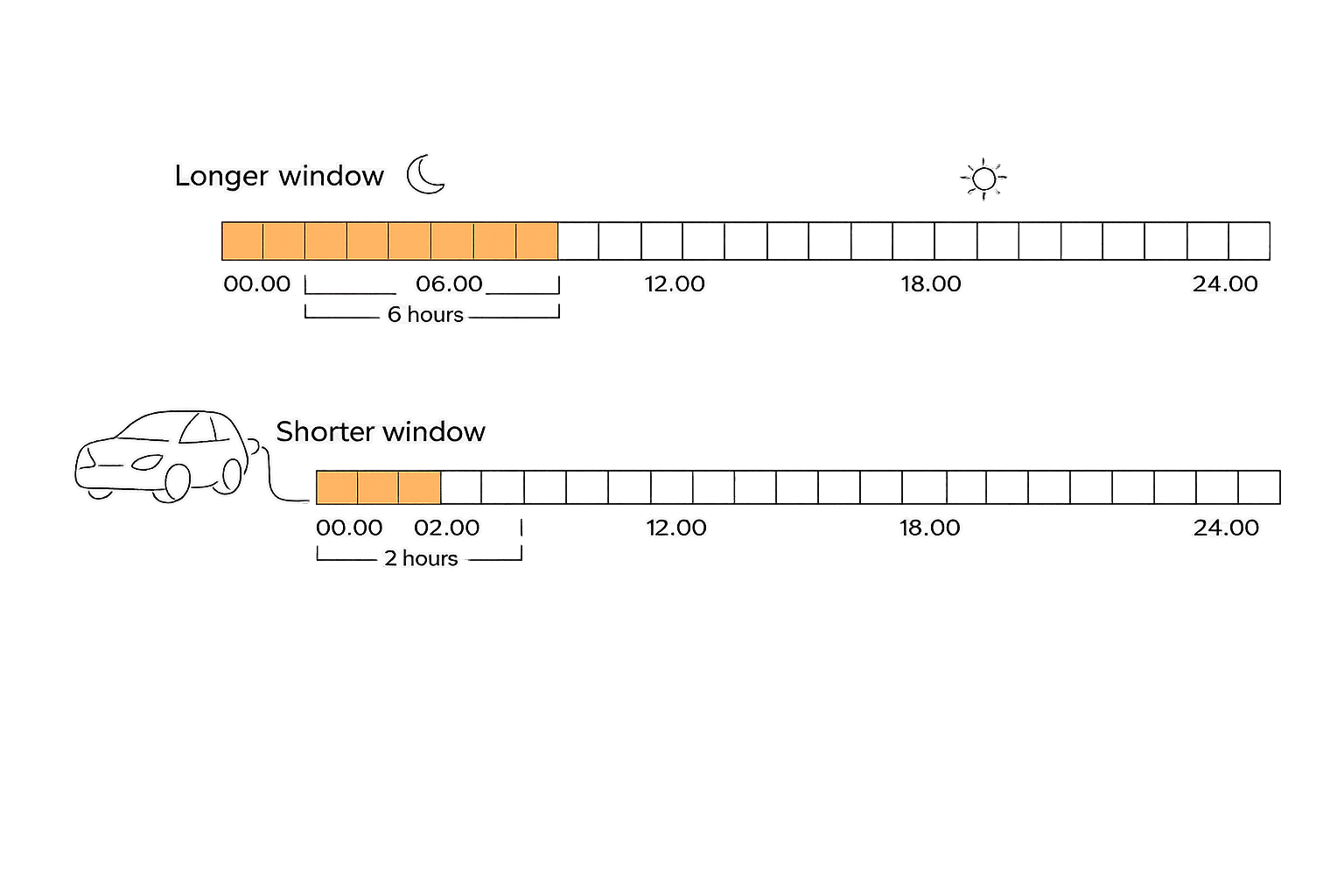
The windows
Two hours at one end, six at the other.
These are the discounted charging windows currently published by the main Irish suppliers. The hours are structural and change rarely. The rates attached to them move often, so they are not listed here.
| Supplier | Plan | Window | Length |
|---|---|---|---|
| Electric Ireland | Night Boost | 02:00 to 04:00 | 2 hours |
| Bord Gáis Energy | Smart EV | 02:00 to 05:00 | 3 hours |
| Flogas | EV Night Charge | 02:00 to 05:00 | 3 hours |
| Energia | EV Smart Drive | 02:00 to 06:00 | 4 hours |
| SSE Airtricity | Smart EV Max | 23:00 to 05:00 | 6 hours |
When the window really matters
A home battery is where a short window starts to bind.
This is the case the window length is really about. Home battery inverters charge at 3 to 5kW, slower than a car charger’s 7.4kW. A 10 kWh battery can take two to three hours to fill on its own, which is most or all of a short window before the car has drawn a single kWh.
Once you are filling a battery and a car in the same slot, a six hour window at a slightly higher rate can beat a two hour one at a lower rate, simply because you can physically get the energy in. The cheap rate you cannot use is not a saving.
The rule of thumb
Count the energy you can move, not the rate.
Charger power in kW, times the window in hours, minus what a battery takes first. That is the most you can buy cheap. A longer window at a slightly higher rate often wins.
For a car on its own
If it’s just the car, even two hours is usually plenty.
Without a battery in the mix, most people don’t need to worry about this. A 7.4kW home charger puts roughly 15 kWh into the car in a two hour window and about 44 kWh in a six hour one.
into the car in a two hour window
in a six hour window
Average driving here is about 8 to 9 kWh a day. So even the shortest window covers several days’ driving in a single night, and most car-only households will never feel the difference between two hours and six.
Where it bites even without a battery is a deep charge from near empty, or charging on a three pin cable at 2.3kW, which turns a three hour window into about 7 kWh.
A separate thing to watch
A very cheap band usually means a very expensive rest of the day.
This is not about the window length, but it decides whether an EV plan is worth taking at all. EV plans price the rest of the day above a standard tariff. The discounted band is paid for by everything outside it, so the plan only pays off if you can genuinely shift most of your usage into the window.
Worth knowing
Pinergy withdrew its EV Night Time tariff from sale in May 2026 and raised the night rate on it substantially. That plan had one of the cheapest bands in the market and one of the highest rates outside it.
How to check your own
Work out the energy you can shift, not the cents you might save.
Take your charger’s power in kW, multiply by the window length in hours, and subtract whatever a battery would take first. That is the most you can buy at the cheap rate. Everything else in the house runs on the day rate, which on these plans is higher than it would be elsewhere.
If you have a smart meter, you can download your own half-hourly data free from ESB Networks and see how much of your usage already falls inside each window before you commit to anything.
Windows above are as published by each supplier and were last checked in July 2026. Suppliers change plans without notice, so confirm the current terms before switching.